The Moment I Said Enough
There is a version of you that already knows what needs to change. You see it every morning when you wake up and feel that strange dissatisfaction — not misery, not pain, just a quiet, nagging sense that you are living slightly less than the life you are meant to lead.
That feeling has a name. It is called comfort. And it might be the most dangerous thing in your life right now.
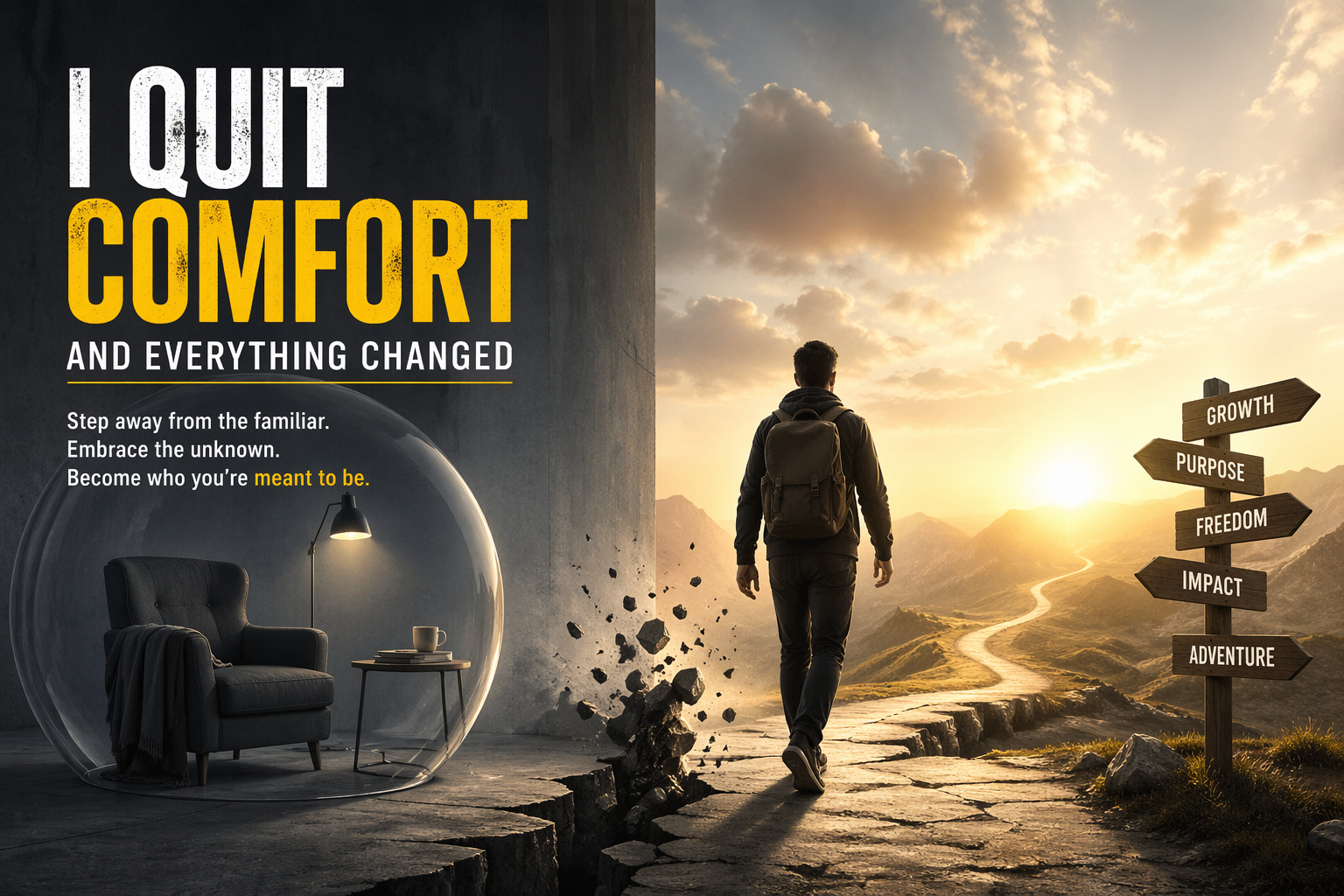
I know because I have been there. Not metaphorically — I mean, I have sat in the exact chair of “this is fine,” rationalizing my way through days that looked safe on paper but felt hollow in the chest. And then I decided to quit. Not quit a job. Not quit a relationship. I quit comfort itself as a lifestyle choice. And everything — truly everything — changed.
This is not another blog post full of motivational quotes and vague advice. This is a real conversation about what happens when you deliberately step away from the familiar, why it is terrifying, and why it is the single best investment you will ever make in yourself.

The Comfort Zone Myth Nobody Talks About
Why Comfort Feels Safe But Costs You Everything
Here is the uncomfortable truth: comfort is not peace. Comfort is the absence of growth disguised as contentment. When you are truly comfortable for too long, you are not resting — you are shrinking.
Think about a muscle that never gets resistance. It does not stay the same; it atrophies. The same is true for your ambition, your creativity, and your capacity for courage. Comfort is slow atrophy dressed up as stability.
“Comfort is not peace. It is the absence of growth disguised as contentment.”
Most people confuse their comfort zone with their identity. They say things like “that’s just not who I am” or “I am not the kind of person who takes big risks.” But those are not facts about who you are — they are habits you have built around what you are used to. There is a difference, and recognizing it is the first step to everything.
The Science Behind Staying Stuck
Psychologists call it the “status quo bias” — the human brain’s tendency to prefer familiar options, even when better alternatives clearly exist. Studies show that people routinely choose a known outcome over an uncertain one, even when the uncertain option has a higher expected value. This is not a weakness. It is evolution. Our brains are wired to conserve energy and avoid perceived threats.
70%
Many people never pursue their biggest goals due to fear of failure
2x
More likely to regret inaction than action, studies show
85%
Many entrepreneurs say their biggest growth came from discomfort
5 Things That Happen When You Quit Comfort
- Your identity expands. You discover capabilities you did not know you had. Every new challenge you survive adds to your sense of what you are capable of — and this changes how you see every future obstacle.
- Your fear loses its power. The more times you act despite fear, the less convincing fear becomes. It does not go away, but it stops being the final word on your decisions.
- Your relationships deepen. Growth attracts growth. When you begin to change, the people around you either rise with you or reveal themselves to be anchors rather than sails. Either way, you gain clarity.
- Your self-respect compounds. Every promise you keep to yourself — every uncomfortable thing you do anyway — builds an internal bank of self-trust. This is the source of genuine confidence, not bravado.
- Your purpose becomes clearer. When you stop filling every moment with comfortable distractions, you hear more clearly what you are actually meant to be doing. Discomfort creates space for clarity.
How to Leave Your Comfort Zone Without Burning Everything Down
Here is where most comfort-zone advice goes wrong: it tells you to make one big, dramatic leap. Quit your job tomorrow. Move countries. Bet everything on your dream. While bold moves have their place, sustainable growth is usually built through smaller, consistent acts of deliberate discomfort.
Start With a Micro-Disruption
A micro-disruption is a small, low-stakes action that breaks a familiar pattern. Take a different route to work. Start a conversation with a stranger. Attend an event outside your industry. These are not grand gestures — they are signals to your brain that novelty is survivable. They are the warm-up sets before the heavy lift.
Practical Examples of Micro-Disruptions
- Write and publish your first opinion piece online (even if it feels exposed)
- Apply for an opportunity before you feel fully ready
- Call someone you admire and ask for 15 minutes of their time
- Say no to something comfortable that is stealing your time
- Start the project you have been “planning” for six months.
Reframe Risk as Data
Every risk you take, successful or not, gives you data. The business idea that failed taught you about markets, timing, and your own resilience. The uncomfortable conversation that went badly taught you about communication and relationships. When you start treating risks as experiments rather than existential threats, the entire game changes.
Entrepreneurs understand this deeply. The founder who has failed three times and tried again is not reckless — they are among the most data-rich, risk-intelligent people in any room.
Build Before You Leap
Leaving your comfort zone is not the same as being unprepared. I moved to Australia, but I came with education, a willingness to learn, and the discipline to start at the bottom and work up. Courage and preparation are not opposites. True boldness is calculated — it considers the downside, plans for it, and moves anyway.

What Fear Is Really Telling You
Fear is not your enemy. It is your oldest and most loyal advisor — one that was optimized for a world that no longer exists. When fear shows up, it is not evidence to stop. It is evidence that you are on the edge of something that matters.
The things worth doing — building a business, making a meaningful contribution, becoming the person you are supposed to be — they all come with fear. The question is never “How do I stop being afraid?” It is “What is worth being afraid of?”
“Fear is not evidence that you should stop. It is evidence that you are on the edge of something that matters.”
One of the most powerful reframes I have ever encountered is this: at the end of your life, you will not regret the risks you took that did not work out. You will regret the risks you never took. You will regret the version of yourself you left behind because comfort was more accessible than courage.
That knowledge changes the calculus entirely. Suddenly, staying safe is the riskiest thing you can do.
The Life You Want Is Waiting on the Other Side of Comfort
The most honest thing I can tell you is this: I did not have a clear map when I chose to quit comfort. I had a direction, I had values, and I had a willingness to learn from every outcome — good and bad. That was enough to start.
Your comfort zone will tell you to wait until the timing is perfect, until you have more resources, until you feel more ready. But readiness is not a precondition for growth — it is the result of it. You do not find readiness and then move. You move, and readiness builds itself around your action.
Quit comfort. Not once. Not dramatically. Quit it every single day, in the small choices and the large ones, until the version of yourself you are becoming starts to feel more familiar than the version you left behind.
Everything you want is on the other side of a decision you are currently delaying.
Make it today.

My Story: From a Village in Andhra Pradesh to Australia
Starting at the Bottom — And Meaning It
I grew up in Pedaparimi, a small village in Andhra Pradesh. Life there was simple, grounded, and full of community. But it also had real limitations — the kind that made you feel, early on, that your ceiling had been set by geography and circumstance. I refused to accept that ceiling.
In the early 2000s, I moved to Australia: a new country, a new language, a new everything. There was no glamour in it. But there was profound wisdom.
What I learned from starting at the bottom: Humility is not weakness. It is the foundation of every durable success. When you are willing to do the unsexy work, you build capabilities that people who skipped to the top never develop. Those capabilities compound over time — and that compounding is what separates leaders from momentary winners.
The Decision That Changed Everything
There came a point where staying comfortable — in a stable job, in familiar patterns, in the safety of “it’s working well enough” — was the very thing holding me back. I could feel the gap widening between who I was and who I knew I could become.
So I chose discomfort, deliberately. I stepped into real estate development, into high-stakes decisions, into building Srini Group from the ground up. I said yes to Signature Wollongong — a 22-storey luxury development that would become the tallest building in Wollongong. I said yes before I had all the answers. I said yes because staying comfortable was no longer an option I was willing to accept.
The project was not easy. Nothing worth building is. But it was completed in 2020, standing tall as proof that the decision to move beyond comfort is never as reckless as the comfort-loving brain makes it feel.
This article was thoughtfully crafted by a dedicated team of content writers and authors from the desk of Srini Group (srini.com.au). The Srini Group is a prominent Australian company specializing in active asset development, property management, and community projects. Founded by entrepreneur and philanthropist Sateesh Muvva, the organization operates through divisions like Petroform, MSR Developments, and the Sri Muvva Foundation. Explore more about his journey in innovation, advocacy, and giving back at sateeshmuvva.com.