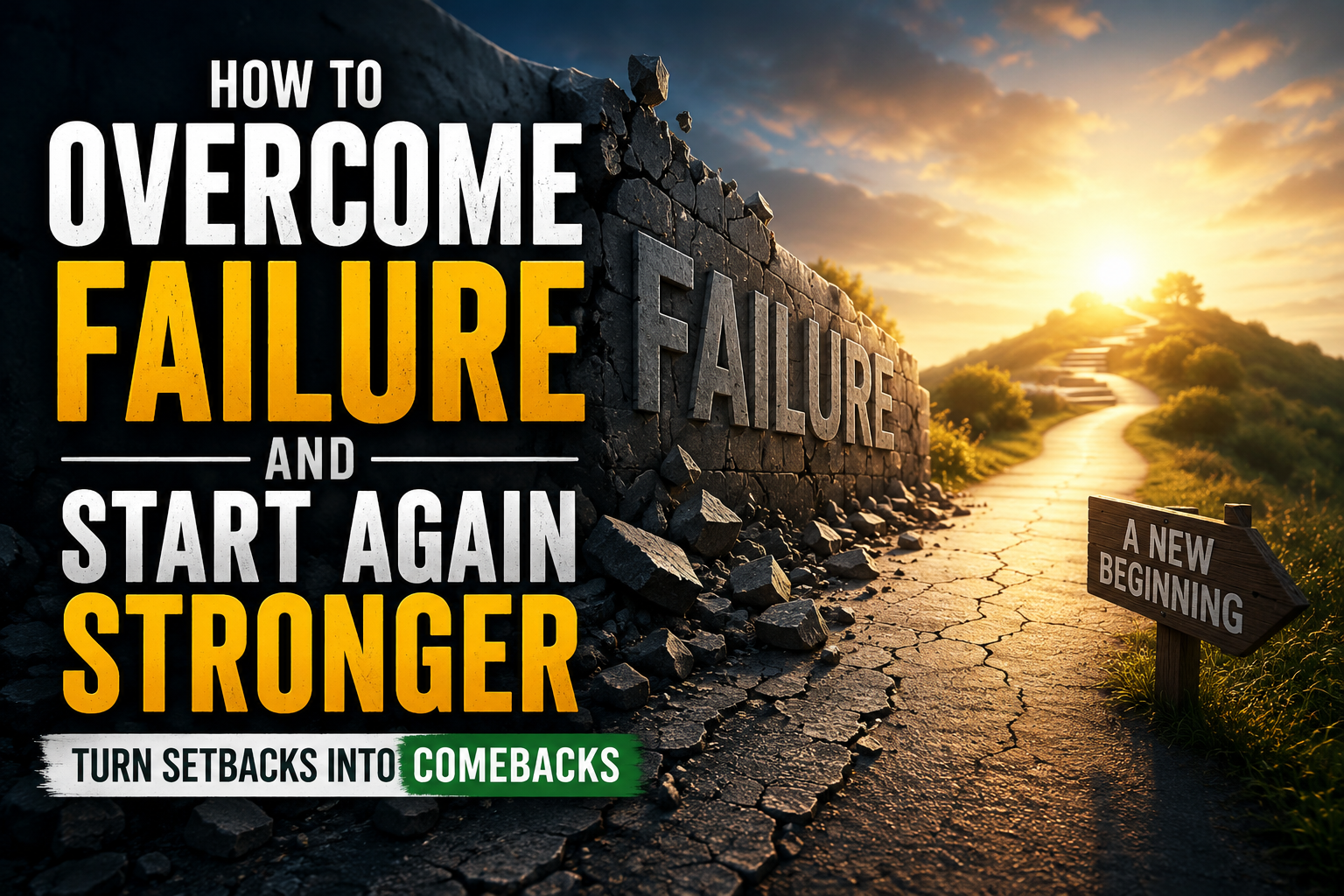
There’s a moment every person knows, but almost nobody admits out loud. It’s when everything you built, planned, or believed in collapses — and you’re left staring at the rubble, wondering if starting over is even worth it. This article is written for that moment.
Picture this: It’s late at night. The business plan you spent eight months building is gone. The partnership dissolved. The loan is overdue. And somewhere between the silence and the ceiling, a single, suffocating question takes hold — Is it over for me?

That question has visited every person who has ever tried to build something meaningful. It visited the entrepreneur who lost her first company at 32. The student who failed his board exams twice. The father watched his savings disappear in a bad investment. And yes — it has visited some of the most accomplished people in the world, long before the world knew their names.
The difference between those who were destroyed by failure and those who were defined by it was not talent. It was not luck. It was a single, deliberate, almost defiant decision: to start again.
This article is not about toxic positivity. It’s not going to tell you to “just believe in yourself” and hand you a motivational quote to plaster on your bedroom wall. This is about the real, uncomfortable, and often unglamorous work of overcoming failure — and what it actually takes to rebuild from the ground up.
The Lie We Were Told About Failure
From the time we sat in school classrooms, the message was consistent: failure is bad. Failure means you weren’t good enough, smart enough, or hardworking enough. The red marks on the exam paper, the disapproving glance when results came in — all of it embedded a single, toxic belief into our psychology: failure is a reflection of your worth.
It is not. And that belief has quietly kept millions of people from ever trying again.
The most damaging thing about this lie is not what it says about failure — it’s what it prevents. When we treat failure as a verdict on our character rather than information about our approach, we stop experimenting. We stop risking. We stop starting. We choose the small, safe, predictable life over the bold, uncertain, meaningful one — not because we don’t want more, but because we’ve been conditioned to believe that falling proves we were never capable of flying.
“I have not failed. I’ve just found 10,000 ways that won’t work.”
— Thomas Edison
Edison’s quote is famous because it captures something we all know instinctively but rarely dare to practise: failure is feedback, not finality. The question is never whether you failed. The question is what you do with it.
What Science Actually Says About Bouncing Back from Failure
Let’s talk about evidence — because the data on resilience and recovery from failure is far more encouraging than the cultural narrative suggests.
20%
More likely to succeed — entrepreneurs who previously failed vs. first-timers (Harvard Business School)
66
Average days to form a new habit — rebuilding takes time, not willpower spikes (European Journal of Social Psychology)
87%
High-performing CEOs attribute their success to consistent daily habits — not talent or timing (McKinsey, 2023)
Research by psychologist Carol Dweck at Stanford University confirmed across decades of study that individuals who view their abilities as developable — rather than fixed — not only recover faster from failure, they perform better over the long term. This is the growth mindset, and it is, in essence, the scientific foundation for every comeback story ever told.
Neuroscience adds another layer. Studies from the University of Michigan found that brief self-reflection after failure — specifically asking “what can I learn from this?” rather than “why did this happen to me?” — activates the prefrontal cortex, the brain’s problem-solving centre, and measurably reduces the cortisol spike associated with stress and shame.
In plain terms, the way you think about failure changes the biology of how you recover from it. This isn’t motivation — it’s a mechanism.
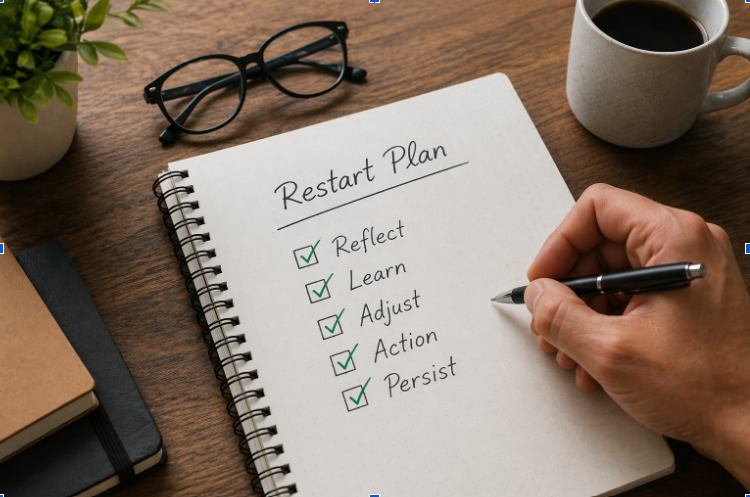
The 3 Hidden Phases of Overcoming Failure
Most people believe that overcoming failure is a single act — a decision made, and then executed. In reality, it unfolds in phases, and understanding those phases is what separates people who recover with direction from those who recover by accident.
The Processing Phase
The period immediately after failure, when grief, embarrassment, and disorientation are not only normal — they are necessary. Rushing past this phase is the fastest way to ensure you repeat the same mistakes. Give yourself the space to feel it fully, without shame and without indefinite wallowing. Process with purpose.
The Audit Phase
Before you rebuild, you must understand what broke. This is not a blame session — it’s an honest inventory. What decisions led here? What assumptions were wrong? What would you do differently? The audit phase transforms failure from a wound into a map.
The Rebuild Phase
Now you begin again — but not as the same person who first started. The rebuild phase is characterised by deliberate action, adjusted strategy, and a fundamentally different relationship with uncertainty. You don’t rebuild in spite of what happened. You rebuild because of it.

7 Hard Truths About Starting Again (That Nobody Tells You)
These are not comfortable insights. They are true ones. And truth, however uncomfortable, is the only foundation worth building on.
Truth #1
Failure Is Data, Not a Verdict
The most liberating reframe available to anyone who has failed is this: failure tells you about your approach, not your identity. A business that failed doesn’t mean you’re not a business person. A relationship that ended doesn’t mean you’re not worthy of love. A goal you didn’t reach doesn’t mean the goal was wrong. Separate the outcome from the person. Then use the data.
Truth #2
The Restart Is the Hardest Step — And It Has Nothing to Do With Action
Most people believe the hardest part of starting again is the doing. It’s not. It’s the deciding. The moment between “this is over” and “I’m trying again” is where the real battle is fought — entirely in the mind. Once you decide, genuinely decide, the actions almost organise themselves. The obstacle is rarely external. It is the conversation inside your own head.
Truth #3
Shame Is the Silent Killer of Second Chances
Failure in front of others — whether it’s a public business collapse, a failed exam, or a dream that didn’t survive — carries a weight that personal failure doesn’t: the weight of perceived judgment. And that shame, that fear of what others think, has buried more second acts than any external obstacle ever could. The truth is that the people watching your life are far less interested in your failure than you imagine. They are too busy managing their own.
Truth #4
Your Identity Must Change Before Your Strategy Does
Here’s what nobody says at the motivational conference: if you go back to doing the same things with the same beliefs about yourself, you will arrive at the same outcome — regardless of how polished your new plan is. A genuine restart requires asking a more fundamental question: who do I need to become to achieve this? Strategy is downstream of identity. Fix the identity first.
Truth #5
New Beginnings Demand New Environments
You cannot grow a new version of yourself in the same soil that produced the old one. The environment you inhabit — the people around you, the information you consume, the physical spaces you occupy — shapes your trajectory more powerfully than motivation ever will. If you’re serious about starting again, assess your environment with the same rigor you apply to your strategy. Some things — and some people — must be left behind.
Truth #6
Speed of Recovery Beats Perfection of Comeback
The pursuit of a perfect comeback is one of the most elegant forms of self-sabotage. People spend years waiting to restart until the conditions are right, the plan is perfect, and the timing is ideal. Those conditions never fully arrive. The most successful restarts in history were not perfect — they were early. Get moving before you feel ready. Momentum is a resource. Waiting depletes it.
Truth #7
Purpose Outlasts Pain — Always
The people who recover from failure most completely are not those with the best plans. They are those with the deepest reasons for continuing. A ‘why’ that is large enough — one connected to something beyond personal gain, whether it’s family, community, legacy, or service — becomes a force that outlasts discouragement, outlasts setbacks, and ultimately outlasts the failure itself. Find your why. Protect it fiercely.

5 Practical Strategies to Overcome Failure and Start Again
Understanding failure is necessary. Acting on that understanding is what transforms it. Here are five evidence-backed, practically grounded strategies for the rebuild:
1. Conduct a Structured Failure Autopsy
Within two weeks of the failure — not in the raw emotional aftermath, but not too long after either — sit down with a blank page and answer three questions honestly: What actually happened? What decisions contributed to it? What would I do differently? Be specific. Be clinical. The goal is not to assign blame but to extract maximum learning before the lessons fade. This autopsy becomes your most valuable asset going forward.
2. Shrink the Horizon
When you’re starting again, the full scale of what you want to rebuild can feel paralysing. The solution is to shrink your operational horizon ruthlessly. Stop thinking about where you want to be in five years and start thinking about what you’re doing tomorrow. One day, one task, one small win. Momentum is rebuilt in microscopic increments, not grand gestures. Trust the compound effect of small, consistent actions.
3. Redefine What Winning Looks Like — Temporarily
In the early stages of starting again, your definition of success must be recalibrated. If your previous benchmark was a ₹10 crore business, your new benchmark for the next 90 days might simply be “show up every day and do the work.” This is not lowering your standards — it’s resetting your feedback loop so that you’re generating positive signals during the rebuild, rather than constantly measuring against the peak you haven’t yet returned to.
4. Build a Recovery Circle — Not a Support Group
There is a crucial difference between people who tell you it’s going to be okay and people who can actually help you get there. In the recovery phase, you need both — but they serve different functions. Be intentional: identify one or two people who have rebuilt from comparable setbacks, whose judgment you trust, and who will engage with your plans critically rather than just encouragingly. That combination of emotional support and strategic challenge is the environment where comebacks are forged.
5. Anchor Your Restart to a Larger Purpose
Personal ambition is powerful fuel. But purpose — a reason for the work that extends beyond your own comfort and success — is a different class of energy entirely. Before you relaunch, ask yourself: who does this serve beyond me? Whether it’s your family, your community, the people who depend on your business, or the vision of what you want to contribute to the world — connect your restart to that answer. Purpose is not decoration. It is infrastructure.
“Failure is not the opposite of success — it is the price of admission. The question is never whether you paid it. It is whether you stayed in the building.”
Sateesh Muvva: The Man Who Started at the Very Bottom — and Built an Empire
Every principle in this article finds a quiet, powerful embodiment in the real-life story of Sateesh Muvva — an Indian-born entrepreneur who didn’t inherit a business, didn’t have a privileged head start, and didn’t take a shortcut.
Born and raised in Pedaparimi, a small village in Andhra Pradesh, Sateesh grew up understanding the weight of limited opportunity. In the early 2000s, he made a decision that most people in his position would have considered impractical: he moved to Australia — a new country, a new culture, and an entirely uncertain future.
His first job in Australia was not an executive role. It was not a business opportunity. He was working on the floor of a petrol station, learning the basics of fuel retail with his own hands. For many, that gap between ambition and reality — between where you want to be and where you start — is where the spirit breaks. For Sateesh, it was exactly the education he needed.
He didn’t wait for the perfect moment to start. He started with the imperfect one he had.
Chairman of The Srini Group — a multi-division Australian enterprise spanning 18 fuel and retail sites in partnership with BP, Shell, and Caltex. Built from a single petrol station operation, not from capital or connections.
Signature Wollongong (2020) — a landmark property development project representing years of patient, persistent vision. His proudest commercial achievement was born from what he describes as “persistence, hard work, and innovation.”
Sri Muvva Foundation (2015) — founded in memory of his late mother, Muvva Hemalatha, this not-for-profit initiative has delivered a ₹20 lakh clean water purification plant to Pedaparimi village, now serving over 10,000 people daily with a 25-year impact horizon. Sanitation projects, student scholarships, and elder care followed.
Community Partnerships — Sateesh has supported the Dapto Rotary Club in Australia, offering land for community services, extending his belief that contribution is not optional — it is inherent to the work.
His story is not a fairy tale. There were no sudden windfalls. No overnight moments. What Sateesh built was the product of years of invisible work, recalibration, and a stubborn refusal to let circumstances define the ceiling.
He is, in the most genuine sense, a living answer to the question this article was written to address. You do not overcome failure by pretending it didn’t happen. You overcome it by becoming someone it couldn’t stop.
“It wasn’t easy, but it taught me a lot: discipline, humility, and the ability to keep going even when things didn’t look promising.”